Coffee bean cooler capacity explained: green weight, roasted weight and recommended load
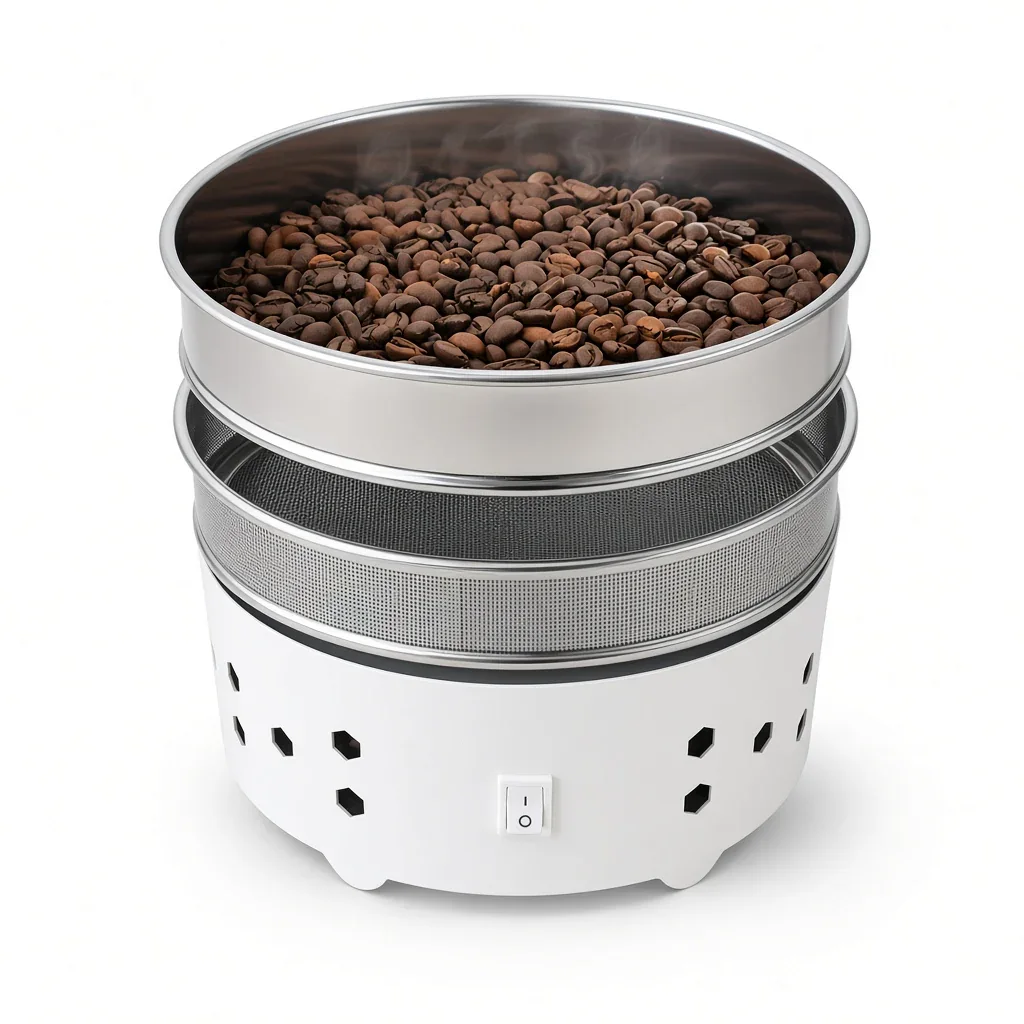
In short:
Choose by an explicitly documented recommended roasted-bean load, then compare it with the weight of your roasted batch. A headline capacity alone is insufficient when its weight basis is undefined. ICOSONICOF advertises its cooler as 360 g, but the product page does not explicitly say whether that figure refers to green or roasted beans. It therefore leaves that particular buying question unresolved.
When interpreting coffee bean cooler capacity, separate three figures: a green-bean weight, a maximum roasted-bean load and a recommended roasted-bean load. These are distinct entries in the ZC-T02-800 specification, providing a useful example of why the wording beside a number matters.
| Capacity entry | What the ZC-T02-800 listing states | How to use it when comparing batches |
|---|---|---|
| Green-bean figure | 800 g green, under “Max. Load” | Keep this separate from the weight of beans after roasting. |
| Maximum roasted load | 650 g roasted, under “Max. Load” | Record it as the listed maximum, rather than substituting it for the suggested capacity. |
| Suggested roasted capacity | 0–600 g roasted beans, under “Suggest Capacity” | Use this stated range for the initial comparison with a roasted batch. |
These figures belong to the ZC-T02-800. They do not define ICOSONICOF’s 360 g label or establish a conversion rule for other coolers.
For a purchase decision, our recommendation is to look for both the weight basis and the recommended load for the exact model. If either is unclear, ask the supplier to clarify it before treating the headline number as a batch-size match.
Match your roasted batch to the documented load
Compare roasted weight with a capacity explicitly stated for roasted beans. To make that comparison, we recommend recording the green starting weight and the roasted output weight separately, rather than using one figure for both.
The Quest Coffee Roaster Handbook, first edition April 2021, states that weight decreases by 12–20% for drinkable roasts while volume increases, with expansion varying by bean type. Treat that as the handbook’s general observation, rather than a guaranteed yield for your next roast. It explains why starting weight and finished weight should not be treated as interchangeable.
For illustration only, suppose a hypothetical batch starts at 400 g green. At an assumed 15% weight loss, its calculated roasted weight would be 340 g: 400 × 0.85. This is an arithmetic example, not a measured roast or evidence that a particular cooler can handle it. Use your own measured roasted output for a buying comparison.
A practical way to read a capacity specification
- Write down the batch weight you are comparing. Label it “green” or “roasted”; keep both if you have them.
- Find the exact model’s capacity wording. Look for an explicit roasted-bean recommendation as well as any maximum-load entry.
- Compare the same weight basis. Do not compare a green starting weight directly with a roasted-bean limit.
- Keep the suggested range separate from the maximum. Use the suggested range as your initial selection criterion; seek clarification if your batch exceeds it.
- Check performance evidence separately. Do not turn a capacity match into a promise about cooling time or final temperature.
The ZC-T02-800 listing illustrates step four: it gives a suggested roasted capacity of 0–600 g and a maximum roasted load of 650 g. In a hypothetical comparison, a 620 g roasted batch would fall below that listed maximum but above the suggested range. We would therefore ask the supplier about suitability rather than describe it as a match to the suggested capacity.
That distinction is useful even without a cooling test: it lets you identify whether a batch falls within the supplier’s stated recommendation. It does not establish how quickly or evenly the batch will cool.
Resolve an unclear capacity label before choosing
If the specification clearly states a recommended roasted-bean load, use it to shortlist a cooler against your measured roasted batch. If the listing gives only an unexplained headline weight, our recommendation is to request a written definition before deciding that it suits your batch.
For ICOSONICOF, the product page identifies the cooler as a 360 g cooler. Its batch-size answer repeats that label and gives the tray diameter, without explicitly defining green or roasted weight. A useful enquiry would be:
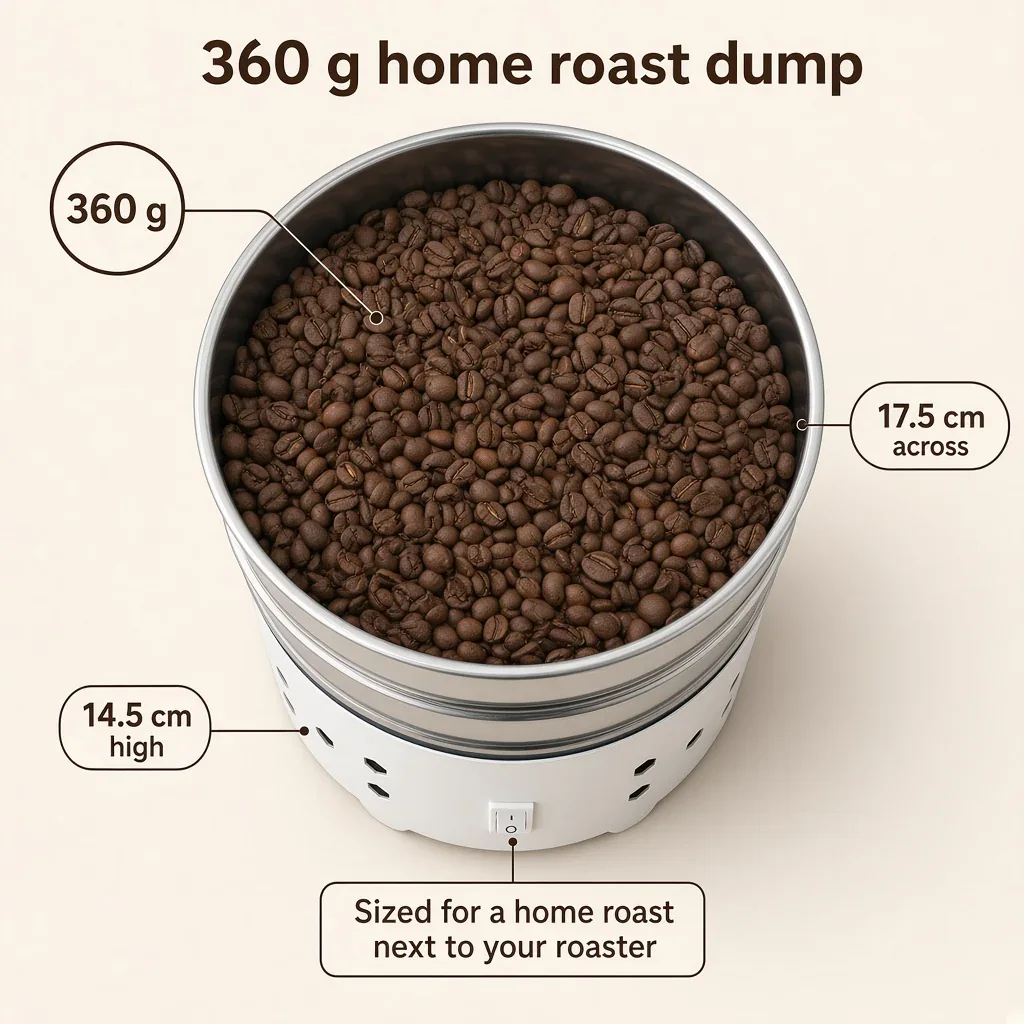
I am comparing this cooler with a roasted batch weighing ___ g. Does the 360 g rating refer to green starting weight or roasted-bean weight? What is the recommended roasted-bean load, and is it different from the maximum load?
Replace the blank with your own measurement when sending the enquiry. If cooling performance is also part of your decision, ask for any documented test at a stated roasted load, including the starting conditions, cooling time and endpoint. Treat an unanswered question as unresolved rather than filling it with an estimate from another model.
Our suggested decision rule is straightforward: proceed with the capacity comparison when the model, weight basis and recommended load are explicit. Seek clarification when those details are ambiguous or your batch lies outside the recommendation. Assess any cooling-performance claim on its own evidence.
Sources to check
- ICOSONICOF’s 360 g cooler product page — the source of the advertised 360 g label; the page does not define whether that figure is green or roasted weight.
- ZC-T02-800 product specification — the model-specific example distinguishing green weight, maximum roasted load and suggested roasted capacity.
- Quest Coffee Roaster Handbook, first edition April 2021 — the attributed explanation of weight loss and volume increase during roasting.