Home Coffee Bean Cooler Explained: A UK Buyer's Guide
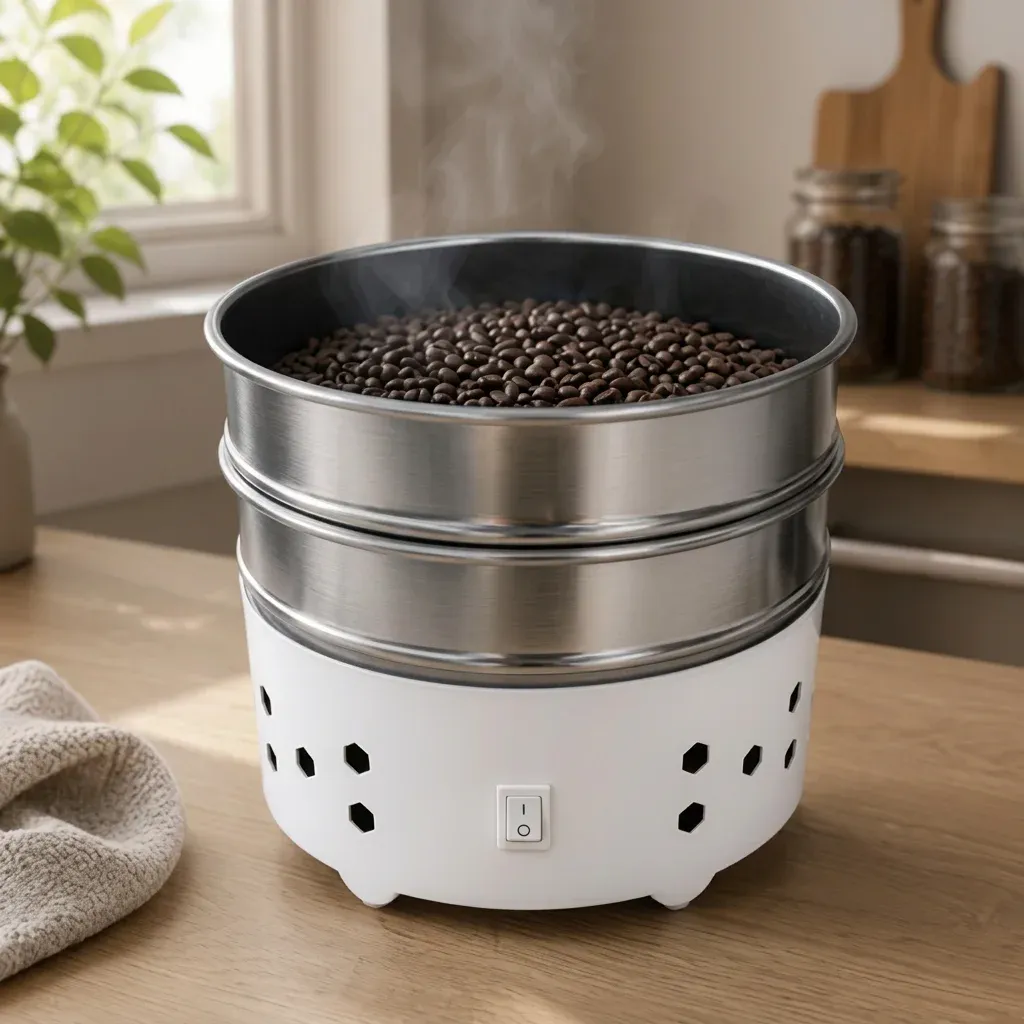
In short: This 360 g ceramic-white cooler sits next to a home roaster. Tip hot beans onto the upper 5-mesh sieve, switch on the 20 W fan, and stir. Tip hot beans onto the upper 5-mesh sieve, switch on the 20 W fan, and stir so chaff falls through to the 60-mesh tray.
Key Takeaways
- Prevents Thermal Coasting: A dedicated active cooling tray stops internal pyrolysis instantly, preventing bright light-to-medium roasts from turning flat, baked, or over-developed.
- Rapid Temperature Drop: The 360 g tray is 17.5 cm across. Stir so beans do not sit in a hot pile.
- Suction vs Airflow Blowing: High static pressure downward suction trays pull heat down and trap loose silver skin chaff in lower mesh filters rather than blowing mess across British kitchens.
- Ceramic-White Surface Advantage: High-contrast ceramic-white trays allow immediate visual roast inspection under standard lighting, making defect identification and colour grading seamless.
- UK Electrical Standards: This cooler runs on 220–240 V, 50 Hz. Switch it on with the rocker on the front of the base.
A home coffee roaster cooling tray is an essential post-roast cooling appliance designed to rapidly extract thermal energy from freshly roasted coffee beans immediately after discharge. For home coffee roasters across the UK, mastering the roast profile does not end when the beans drop from the roaster drum or fluid bed chamber. In reality, one of the most critical phases of roasting begins the exact millisecond those beans land in the discharge hopper: the cooling phase. Without immediate forced thermal extraction, coffee beans undergo an unwanted phenomenon known as thermal coasting, where internal stored heat continues to cook the bean core, destroying delicate origin notes, muting acidity, and flattening complex fruit aromatics into dull, baked profiles.
This guide covers the 360 g ceramic-white coffee bean cooler for UK home roasting. We look at colander and baking-tray cooling next to this 360 g ceramic-white cooler, with a 20 W fan in the base and two 304 stainless sieves.
What is a Home Coffee Roaster Cooling Tray and Why Is It Essential?
A home coffee roaster cooling tray is a specialized post-roast processing appliance engineered to draw internal heat rapidly out of freshly discharged coffee beans. When raw green coffee is roasted, it absorbs significant thermal energy during the endothermic phase before transitioning into an exothermic state around First Crack. Consequently, when you drop your roast at temperatures ranging from 195°C to 225°C, the internal bean structure acts like an insulated thermal reservoir.
If hot coffee is left to rest in a bowl, colander, or static tray at ambient UK room temperatures, the core of each bean remains far hotter than its exterior shell. As a result, internal temperatures remain high enough to sustain pyrolytic reactions for several minutes after the roast has nominally ended. This residual heat propagation is what professional roasters refer to as thermal coasting.
How Does Thermal Coasting Affect Coffee Bean Flavour?
During the roasting cycle, sugar caramelisation, Maillard reactions, and organic acid development (specifically chlorogenic, citric, and malic acids) dictate the final cup flavour profile. Stopping these chemical transformations at the exact target end-temperature is essential for profile consistency and batch-to-batch repeatability.
Furthermore, if cooling takes longer than 3 to 4 minutes, chlorogenic and citric acids break down rapidly into quinic and caffeic acids, giving the brewed coffee a harsh, medicinal bitterness. In addition, volatile aromatic compounds—such as aldehydes, esters, and pyrazines responsible for jasmine, stone fruit, and bergamot notes—evaporate rapidly when exposed to prolonged residual heat.
Industry Standard: According to UK specialty coffee guidelines and thermal dynamics research published by the Specialty Coffee Association (SCA) Technical Standards Board, green bean cooling kinetics dictate that tip hot beans onto the 5-mesh sieve, switch on, and stir. Keep the fan grille clear. Stir so beans do not sit in a hot pile.
Can You Cool Coffee Beans Without a Cooling Tray? (Passive vs Active Cooling)
Many home roasters starting their journey across the UK begin with improvised cooling methods: transferring hot beans into kitchen colanders, shaking stainless steel strainers, spreading beans over baking trays near open windows, or using a domestic hairdryer on a 'cool' setting. However, while these methods are inexpensive, they introduce significant roast defects and domestic mess.
1. Inconsistent Air Distribution and Hot Spots
Passive cooling relying on ambient UK air currents cools only the outer boundary layer of the bean mass. Consequently, beans situated in the centre or bottom of a colander pile remain trapped at temperatures above 150°C, continuing to roast internally while outer beans cool down. Ultimately, this creates uneven roast levels within a single batch.
2. Chaff Contamination Across British Kitchens
Silver skin (chaff) detaches rapidly during First and Second Crack. Attempting to cool beans using an upward-blowing fan or hairdryer scatters lightweight, papery chaff across your kitchen worktops, floors, and appliances. This cooler uses a 20 W fan in the base to pull air down. Beans stay on the 5-mesh sieve; chaff drops into the 60-mesh tray.
3. Thermal Shock and Structural Bean Cracking
While rapid cooling is critical, blowing freezing air directly over hot beans via improvised high-speed blowers can introduce severe thermal shock, leading to micro-fractures in the cellulose matrix of the coffee bean. Conversely, active suction cooling trays pull ambient room air evenly through the entire bean bed, delivering controlled, uniform convective heat exchange without damaging bean cell walls.
What Key Specifications Should You Look For in a UK Home Cooling Tray?
When investing in an active home coffee roaster cooling tray, evaluating key technical parameters ensures you select an appliance engineered for longevity, ease of use, and superior thermal performance. Look for these parts on the 360 g ceramic-white cooler:
1. Downward Suction vs Upward Airflow
Always opt for downward suction airflow systems over upward blowers. Downward suction draws heat away from your face and traps chaff in a secondary lower filter basket beneath the cooling screen, maintaining a clean workspace.
2. High-Contrast Ceramic-White Inspection Surface
Evaluating roast uniformity requires accurate visual feedback. Traditional stainless steel or dark mesh trays reflect glare and obscure subtle color variations. A food-grade, heat-resistant ceramic-white tray provides maximum color contrast, making it easy to identify quakers (under-developed beans) and roast defects immediately.
3. High Static Pressure Fan and Airflow Rate
Look for high CFM (cubic feet per minute) brushless induction motors. A high-efficiency motor ensures continuous airflow when a 360 g home roast dump sits on the 5-mesh sieve.
4. UK Electrical Safety and Mains Voltage
According to UK electrical standards, appliances for UK home roasting should run on 220–240 V, 50 Hz. This cooler has a rocker on the front of the base.
Frequently Asked Questions About Home Coffee Roaster Cooling Trays
How fast should coffee beans be cooled after roasting?
Tip in the hot beans, switch on the rocker, and stir. Keep the fan grille clear. Stir so beans do not sit in a hot pile.
Why is downward suction better than blowing air for cooling coffee?
Downward suction pulls ambient air through the bean mass into a sealed lower compartment. Consequently, heat and silver skin chaff are drawn downward into an integrated filter basket rather than being scattered across your kitchen worktops.
What batch size is this version for?
This ceramic-white version is the 360 g cooler. The tray is 17.5 cm across. Tip in a home roast dump, switch on, and stir so the beans do not sit in a hot pile.