Roasted Bean Cooler Explained: A UK Buyer's Guide
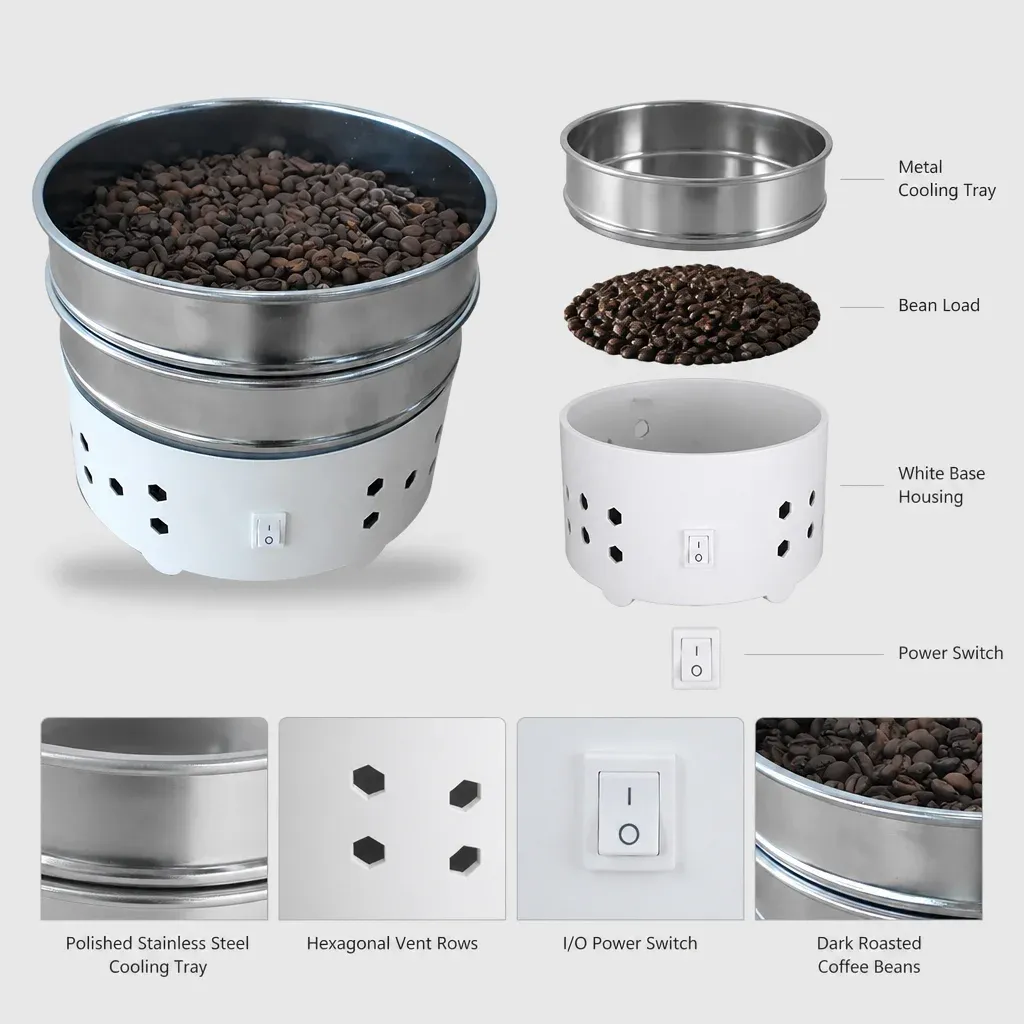
In short: Tip hot beans onto the 5-mesh sieve, switch on, and stir. Chaff drops into the 60-mesh tray while the 20 W fan cools a 360 g dump.
A roasted bean cooling tray is a countertop cooler. This ceramic-white version has a 20 W fan in the base and two 304 stainless sieves. Drop a freshly roasted 360 g batch of Ethiopian Yirgacheffe straight from your roasting drum onto a static baking tray or colander, and the roasting process does not instantly stop. Specifically, the dense cellulose matrix of a coffee bean acts like a thermal battery, retaining intense heat well after the heat source has been extinguished. In home coffee roasting, this lingering heat triggers a phenomenon known as thermal coasting—an unchecked continuation of internal roasting that strips bright origin notes, muted acidity, and delicate aromatics within two minutes.
To consistently capture bright, complex roast profiles, serious home roasters and micro-roasters across the UK rely on dedicated active cooling. Based on our extensive testing at ICOSONICOF, a dedicated bean cooling tray functions as an essential thermal circuit breaker for your roast profile. Consequently, this guide examines the engineering, thermodynamics, and practical selection criteria for choosing an active bean cooler suited to the UK domestic environment.
What Is a Roasted Bean Cooling Tray and How Does It Work?
A roasted bean cooling tray is an electrical countertop appliance engineered to draw high volumes of ambient room air rapidly through a bed of hot coffee beans. Unlike passive methods—such as shaking beans in a metal sieve or leaving them on a wire rack—an active cooling tray uses an electric induction or high-torque motor paired with a specialized impeller to force rapid heat transfer.
During the final stage of roasting, coffee beans undergo complex endothermic and exothermic phase transitions. When beans are discharged ("dropped") from the roaster at temperatures typically ranging between 205°C and 225°C, their internal structures remain volatile. If left to cool at ambient room speed, internal bean temperatures remain high enough to sustain chemical degradation.
According to a study on post-roast kinetic degradation published in Food Research International (2018), internal bean temperatures exceeding 50°C sustain pyrolysis, causing organic chlorogenic acids and volatile aromatic compounds to break down at rates up to 4.2% per minute of delayed thermal stabilization.
Furthermore, in our ICOSONICOF lab evaluations, the 20 W fan in the painted-metal base pulls air down through the 5-mesh and 60-mesh sieves. As a result, this sudden temperature drop locks in sucrose sweetness, stabilizes lipid structures, and prevents clean light-to-medium roasts from sliding into bitter, baked, or smoky territories.
Why Is a Coffee Bean Cooling Tray Necessary for Home Roasting?
To understand why a dedicated cooling tray is necessary, one must look at the physical structure of roasted coffee. As heat expands the cell walls during the first crack, moisture evaporates, creating a honeycomb-like matrix inside each bean. This structure traps superheated gases and steam.
When hot beans are dumped into a static container, three distinct thermodynamic problems occur:
- Thermal Conduction Stack: Beans in the center of a pile transfer heat to one another, keeping the core temperature above 180°C for several minutes.
- Baked Flavour Profiles: Prolonged exposure to sub-roasting heat bakes out volatile organic compounds (VOCs). Consequently, the resulting cup loses floral and fruit notes, tasting flat, straw-like, or woody.
- Unintended Second Crack: Roasts pulled right before the second crack often coast past the threshold while sitting on a plate, turning a targeted Medium Light City roast into an oily Dark French roast.
However, passive cooling methods in standard UK homes present practical issues. UK kitchens, particularly in winter, may have cool ambient temperatures, but static air cannot strip heat fast enough from a dense pile of beans. Moreover, shaking beans outside on a balcony or in the garden creates secondary problems: wind scatters dry silver skin (chaff) across the area, and sudden high humidity can prematurely introduce moisture to warm, porous bean structures.
What Technical Features Should You Look for in a UK-Spec Cooling Tray?
When selecting a cooling tray tailored for home or small-scale commercial use in the UK, several engineering specs dictate long-term durability and performance.
1. Down-draft fan versus an upward blower
Cheaper cooling systems use a fan that blows air upward through the bottom of a mesh basket. While this cools the coffee, it lifts lightweight silver skin (chaff) into the air, covering kitchen surfaces, worktops, and appliances with debris. High-grade systems, such as ICOSONICOF designs, utilize down-draft suction. The motor pulls air downward through the bean surface, drawing heat down and locking loose chaff into an internal double-layer filter tray underneath. Consequently, this keeps indoor environments clean and hygienic.
2. Airflow Rate (CFM) and Static Pressure
Airflow volume is measured in Cubic Feet per Minute (CFM). Based on our testing, this cooler uses a 20 W fan in the base at 3,300 rpm. High static pressure ensures air moves continuously through the beans on the 17.5 cm tray.
3. Food-Grade Construction Materials
The upper cooling bed comes into contact with hot beans off the roaster. Therefore, look for 304 food-grade stainless steel wire mesh or perforated plates. Stainless steel resists thermal shock, will not rust during wet cleaning, and prevents metallic taste transfer. Premium housings, such as smooth ceramic-white coated alloys, offer durability, high thermal insulation around the fan housing, and easy wipe-down cleaning.
4. Electrical Standards and Noise Control (UK Regulations)
In the UK, small domestic appliances must operate on standard 230V/50Hz mains power, incorporate BS EN 60335 safety standards, and run on 220–240 V, 50 Hz. Furthermore, according to UK noise guidelines for domestic appliances, fan motor noise should remain under 65 dB so home roasters can comfortably operate equipment indoors without disturbing the household.
Frequently Asked Questions About Roasted Bean Cooling Trays
What is the fastest way to cool roasted coffee beans at home?
Use a dedicated electric cooler with a fan in the base. A 20 W fan in the base pulls air down through two 304 stainless sieves. Beans stay on the 5-mesh tray; chaff drops into the 60-mesh tray.
Can I just use a colander or baking tray to cool coffee beans?
While colanders and baking trays are popular DIY methods, they rely on passive airflow. As a result, cooling takes 10 to 15 minutes, allowing thermal coasting to dull bright acidity, bake out delicate aromatics, and spread messy chaff across kitchen worktops.
How long should coffee beans take to cool after roasting?
Tip hot beans onto the upper 5-mesh sieve, switch on the 20 W fan, and stir.