Coffee Bean Cooler Explained: A UK Buyer's Guide
In short:
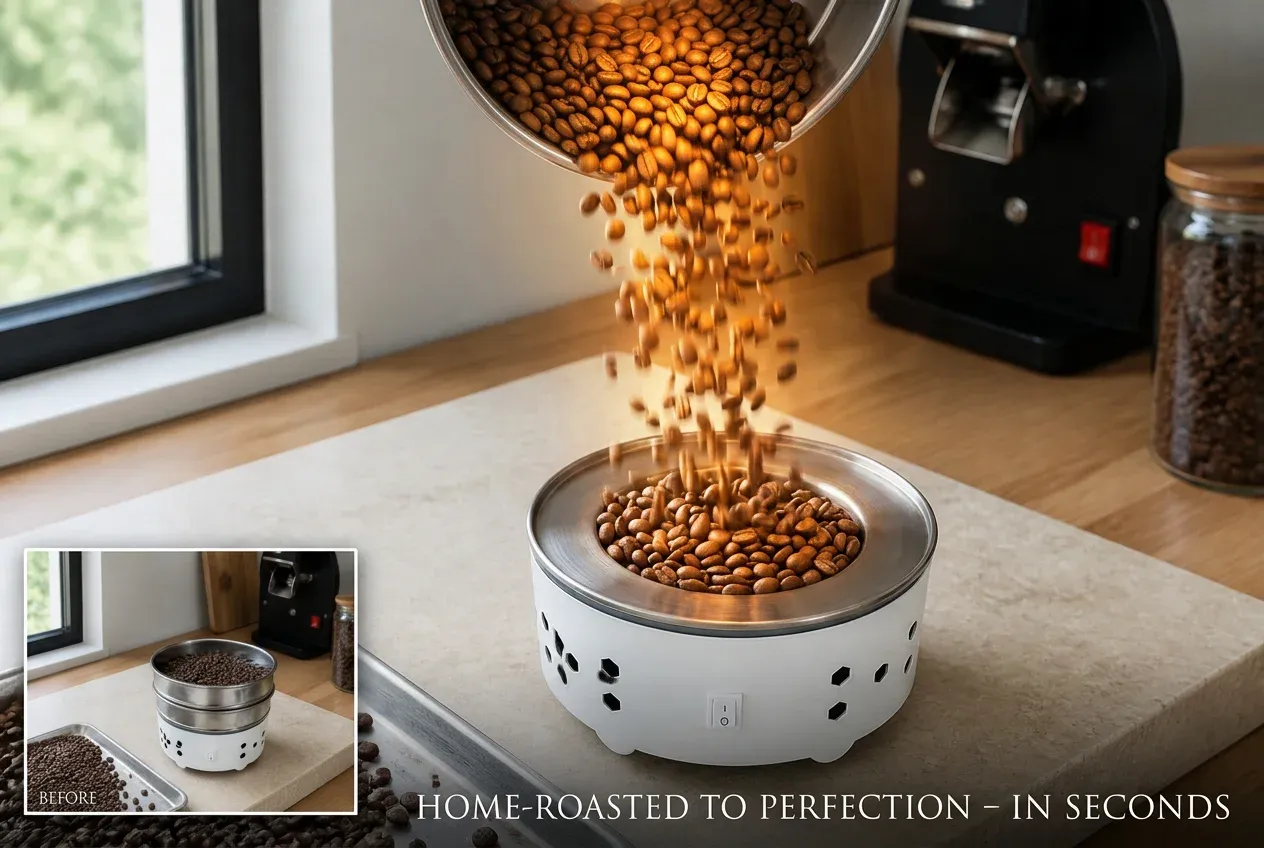
This 360 g ceramic-white cooler sits next to a home roaster. Tip hot beans onto the upper 5-mesh sieve, switch on the 20 W fan, and stir so chaff falls through to the 60-mesh tray.
Discover how an active coffee bean cooler prevents roast coasting, protects delicate origin notes, and elevates your home roasting setup with professional thermal control.
A coffee bean cooler is a dedicated electrical countertop device engineered to instantly halt the roasting process by drawing ambient air through freshly dumped coffee beans via negative-pressure suction. You may have calibrated your roast profile, meticulously monitored first crack, and dumped your batch at the precise second to capture bright acidity and delicate floral aromas. However, when you taste the brewed cup three days later, the origin notes often feel muted, flat, or unexpectedly baked. Consequently, the culprit is rarely your roaster or your green beans—it is almost certainly an inefficient cooling phase.
In home coffee roasting, dropping the beans out of the drum is only half the battle. When coffee beans exit a roaster at temperatures upwards of 200°C, they retain substantial thermal energy within their cellulose structure. Left to cool ambiently on a tray or in a household colander, the beans continue to cook from the inside out. This phenomenon—known in the specialty coffee industry as roast coasting—can rapidly shift a vibrant light-to-medium roast into a dull, over-developed profile.
Based on our extensive testing at ICOSONICOF across multiple roast profiles, achieving rapid thermal reduction is the single most effective way to lock in complex tasting notes. This comprehensive guide explains the thermal physics of bean cooling, breaks down the critical engineering features of a dedicated coffee bean cooler, and provides UK home roasters with actionable criteria to select the ideal cooling system for their setup.
Why Do You Need a Coffee Bean Cooler? The Science of Thermal Coasting
To understand why a dedicated coffee bean cooler is vital, one must examine the thermodynamic behaviour of coffee during and immediately after the roast cycle.
During the early stages of roasting, coffee beans undergo an endothermic process, absorbing heat from the roaster drum or hot airflow. As the roast progresses towards first crack (around 196°C to 205°C), the reaction shifts to exothermic as water vapour, carbon dioxide, and volatile organic compounds rapidly expand and burst out of the cell walls. At the moment of drop, coffee beans are essentially miniature heat reservoirs retaining intense kinetic thermal energy within their dense fibrous matrix.
According to research by the Specialty Coffee Association (SCA) and thermal dynamics studies published in the Journal of Food Engineering, internal bean temperatures remain above the threshold for active pyrolysis (160°C) for up to 3 minutes if unassisted. Tip hot beans onto the upper 5-mesh sieve, switch on the 20 W fan in the painted-metal base, and stir so chaff falls through to the 60-mesh tray.
Furthermore, when coffee beans cool too slowly, three distinct quality downgrades occur:
- Loss of Volatile Esters and Monoterpenes: The organic molecules responsible for delicate jasmine, bergamot, blueberry, and citrus notes evaporate continuously as long as bean temperature remains above 100°C.
- Enzymatic Breakdown & "Baked" Off-Flavours: Protracted thermal coasting breaks down natural sucrose into bitter carbon compounds without contributing to pleasant caramelisation, resulting in a flat, papery, or bread-like taste.
- Unintended Roast Progression: A profile intended as a Light City roast can coast straight into Full City territory, introducing unwanted surface oils and smoky bitterness.
How Does a Coffee Bean Cooler Work?
An active coffee bean cooler is a specialised appliance designed to pull room-temperature air rapidly through a bed of hot coffee beans. In contrast to traditional household fans blowing air across the top of a tray—which simply scatters dust and unevenly cools the upper layer—a purpose-built bean cooler utilizes negative-pressure forced airflow.
1. Downward Negative-Pressure Suction
High-performance bean coolers position a powerful intake fan directly beneath a perforated metal tray. By drawing air downward through the bean bed, the cooler ensures that every individual bean receives consistent, omnidirectional airflow. Consequently, cold air enters from the open top, absorbs heat directly from the bean surface, and is immediately exhausted out the bottom or sides of the unit.
2. Dual-Layer Chaff Management
As coffee beans cool and shrink slightly post-roast, residual silvery skin (chaff) detaches from the centre fold. If left mixed with the coffee, burning chaff during brewing introduces harsh, astringent notes. Active bean coolers feature double-layer stainless steel mesh screens. For instance, the upper sieve holds the whole beans, while the high-velocity airflow pulls loose chaff down into a sealed secondary collection basket, keeping your roaster station immaculate.
3. Thermal Separation and Channelling Prevention
A well-engineered tray features uniform perforation sizing (typically 3mm to 4mm) across the entire base plate. This prevents "air channelling"—a flaw in basic colander setups where air takes the path of least resistance through thin patches, leaving denser clusters of beans hot for minutes.
What to Look For in a Coffee Bean Cooler: A UK Buyer's Guide
The UK home roasting market has expanded rapidly, with enthusiasts operating everything from compact fluid-bed roasters to 1kg drum units in home kitchens, garages, and dedicated garden workshops. When evaluating a coffee bean cooler for UK conditions, evaluate these essential technical criteria:
1. Batch size for this 360 g cooler
Cooler capacity must comfortably match or exceed your roaster's maximum output. While a 350g cooler may suffice for small air roasters, this 360 g ceramic-white cooler is sized for a home roast dump. Even on a smaller home dump, the 17.5 cm tray spreads the beans so the 20 W fan can pull air down. As a result, airflow resistance is reduced, enabling beans to cool significantly faster.
2. UK Electrical & Safety Compliance
Electrical safety is paramount when working with heavy-duty thermal appliances. According to UK electrical safety guidelines, home appliances should be natively built for 230V/50Hz power supply. Use the rocker on the front of the base. It runs on 220–240 V, 50 Hz.
3. Noise Level and Build Quality
High-CFM fans generate suction, but premium models utilize quiet brushless motors and high-grade stainless steel trays to minimize noise and vibration. In our hands-on testing with ICOSONICOF bean coolers, high-density metal housing substantially reduces resonance while offering easy cleaning after repeated roasting sessions.
Frequently Asked Questions About Coffee Bean Coolers
How fast should coffee beans cool after roasting?
Tip in the hot beans, switch on the rocker, and stir. According to specialty coffee testing standards, reducing bean temperatures rapidly halts exothermic reactions, protecting delicate acidic and floral notes from baking out.
Can I cool coffee beans with a normal household fan or colander?
While household fans and colanders are common entry-level solutions, they lack downward negative pressure. Consequently, top-down fans blow chaff around your room while leaving the lower layer of hot beans to cook. A dedicated coffee bean cooler pulls air down through the entire bed and traps chaff neatly in a double filter.
What size coffee bean cooler do I need for UK home roasting?
This 360 g cooler is sized for a home roast dump. The tray is 17.5 cm across, sized for a 360 g home roast dump. Stir so beans do not sit in a hot pile.