The Ultimate Guide to Coffee Bean Coolers in the UK
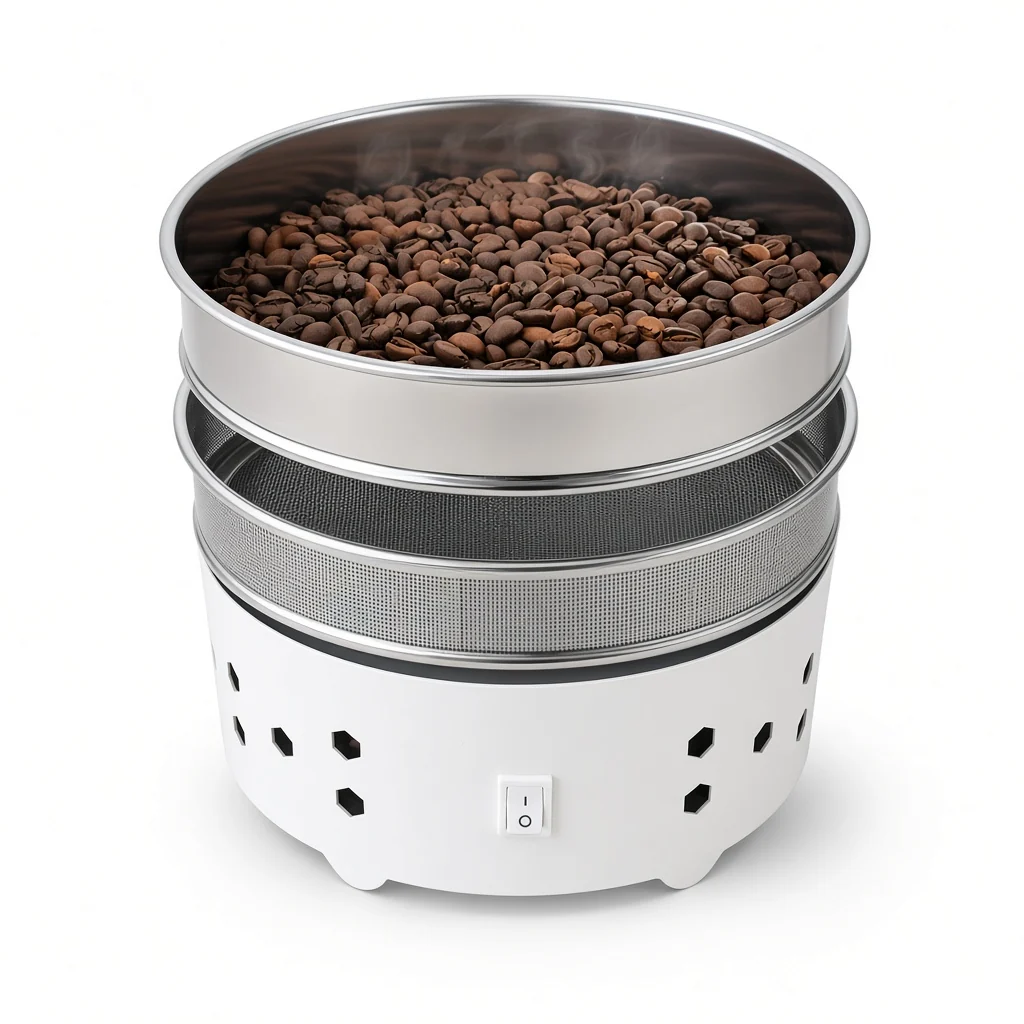
In short: A 20 W fan in the base pulls air down through two 304 stainless sieves. The 360 g ceramic-white tray is 17.5 cm across, sized for a home roast dump.
Key Takeaways
- Thermal Inertia ("Coasting") Destroys Origin Flavours: Left uncooled, freshly roasted coffee beans continue internal pyrolytic reactions for up to 10 minutes, flattening delicate floral and fruity acid profiles into dull, baked notes.
- Keep the bed shallow: The 360 g tray is 17.5 cm across. Stir so beans do not sit in a hot pile.
- Downward Suction vs Upward Airflow: A 20 W fan in the base pulls air down through two 304 stainless sieves. Beans stay on the 5-mesh tray; chaff drops into the 60-mesh tray.
- UK Environmental Factors: Variable British ambient humidity and seasonal indoor temperatures make active cooling essential for reproducible roast profiles year-round.
A coffee cooling tray is a specialized post-roast extraction appliance designed to rapidly pull heat out of freshly discharged coffee beans through active mechanical airflow. The moment raw coffee beans drop from a drum roaster at 200°C to 225°C, thermal kinetic energy reaches its absolute peak. Inside the cellular matrix of every bean, chemical compounds undergo rapid expansion, structural cracking, and volatile gas release. However, the roasting process does not instantly cease when the beans fall into a catch tray. Without immediate physical intervention, dense green coffee converted into light cellular structures holds onto immense internal energy. This retained heat acts like a thermal battery, keeping the core of the bean in an active state of combustion known across the specialty industry as "roast coasting."
For home roasters across the United Kingdom striving to replicate the precision of commercial micro-roasteries, coasting is the silent killer of cup clarity. Consequently, it transforms what should have been a bright, jasmine-scented Yirgacheffe or a complex, blackcurrant-noted Kenyan washed coffee into a flat, indistinct, and unpleasantly baked cup. Stopping heat momentum requires more than spreading hot beans over a cold baking sheet or shaking a sieve by an open window. Instead, it demands active, continuous airflow engineered to draw thermal energy away from the core of the bean bed in seconds.
Based on our testing across popular UK home roasting setups, integrating a dedicated active cooling tray transforms roasting outcomes dramatically. Whether you operate a fluid-bed roaster in a London flat or a 1kg drum roaster in a Yorkshire workshop, mastering the rapid thermal drop is the definitive step toward professional-grade specialty coffee.
Why Do You Need a Coffee Cooling Tray? The Thermodynamics of Roast Coasting
To understand why a dedicated coffee cooling tray is a necessity rather than an optional accessory, one must examine the internal thermodynamics of the coffee bean during the final development phase of a roast. As green coffee transitions through the endothermic drying phase into the exothermic crack phases, moisture content drops from roughly 11% down to 2–3%. Simultaneously, the cellulose matrix expands, creating millions of microscopic pores filled with superheated carbon dioxide and volatile organic compounds.
When you discharge beans from your roaster at your targeted end-temperature—say, 208°C for a vibrant light roast—the external ambient air begins to cool the outer skin of the bean. However, the thermal conductivity of dry cellulose is exceptionally low. As a result, the internal core remains at extreme temperatures, continuing pyrolytic breakdown, sugar caramelisation, and organic acid degradation long after the batch has exited the drum.
"According to UK specialty coffee roasting standards and research published by the International Coffee Organization (ICO) in collaboration with the Specialty Coffee Association (SCA), delaying the thermal reduction of freshly roasted coffee beans beyond 180 seconds results in an average 34% loss of volatile aromatic esters—specifically aldehydes and furans responsible for floral and sweet notes—due to sustained post-drop degradation."
Furthermore, if cooling takes five to ten minutes (typical of passive ambient resting or manual colander shaking), the outer layers of the bean cool while the core continues to bake. This creates an uneven development gradient across the individual bean profile. Ultimately, the result is a cup marked by muted acidity, reduced sweetness, hollow mid-palate flavours, and an unmistakable paper-like or dry woody finish.
How Does the Maillard Reaction Impact Post-Roast Cooling?
The Maillard reaction—the complex chemical interaction between amino acids and reducing sugars—is responsible for producing hundreds of the flavour compounds that define specialty coffee. During roasting, this reaction creates melanoidins, which yield body, complexity, and crema production in espresso. However, allowing the Maillard reaction to run past your intended drop point consumes delicate simple sugars that would otherwise contribute to natural sweetness. An active coffee cooling tray acts as a chemical kill-switch, locking in the exact ratio of acids, sugars, and aromatic oils achieved at the moment of discharge.
How Does a Coffee Cooling Tray Work?
A dedicated coffee cooling tray is an active thermodynamic device designed to force large volumes of ambient air rapidly through a concentrated bed of hot coffee beans. Unlike passive cooling methods that rely on natural convection, an active cooling system uses a high-torque electric induction or brushless motor paired with a specialized impeller fan to generate negative static pressure beneath a fine mesh screen.
Is a down-draft fan better than blowing air up?
Not all cooling trays operate on the same mechanical principles. Early domestic solutions and low-cost alternative devices often rely on blowing air upwards from beneath the bean bed. While this forces air through the beans, it introduces major operational flaws into a home or small-scale roasting setup:
- Chaff Dispersal: Blowing air upward forces light, brittle silver skin (chaff) into the surrounding room, coating worktops, floorboards, and kitchen appliances in fine papery dust.
- Uneven Air Channels: Upward airflow naturally seeks the path of least resistance, creating localized "blow-holes" in the bean bed while leaving dense outer areas hot and uncooled.
- Thermal Efficiency Loss: Upward blowing pushes heat into the face of the roaster operator, making visual inspection and temperature tracking uncomfortable.
In contrast, premium professional-grade systems—such as the ICOSONICOF 360 g Coffee Bean Cooler—use a 20 W fan in the base to pull air down. High-static pressure motors pull ambient air down through the top of the bean bed. The fan in the base pulls air down through two 304 stainless sieves. Beans stay on the 5-mesh tray; chaff drops into the 60-mesh tray.
Frequently Asked Questions About Coffee Cooling Trays
What is a coffee cooling tray and why is it essential for home roasters?
A coffee cooling tray is a forced-air appliance engineered to rapidly reduce the temperature of freshly roasted coffee beans. For UK home roasters, it is essential because passive cooling allows internal bean temperatures to stay high, leading to "roast coasting" which destroys delicate floral and fruit flavour notes.
How fast should coffee beans be cooled after roasting?
Tip in the hot beans, switch on the rocker, and stir. Empty the lower sieve of chaff when you are done. Rapid cooling locks in organic acids and prevents unwanted post-drop baking.
Does a coffee cooling tray collect chaff automatically?
Yes. High-quality systems like the ICOSONICOF coffee cooling tray use downward suction to pull loose silver skin (chaff) down through the mesh screen into a dedicated collector filter, maintaining a clean roaster workstation.