How to Cool Roasted Coffee Beans After the Drop
Build a repeatable post-drop cooling record using time, bean depth and end temperature.
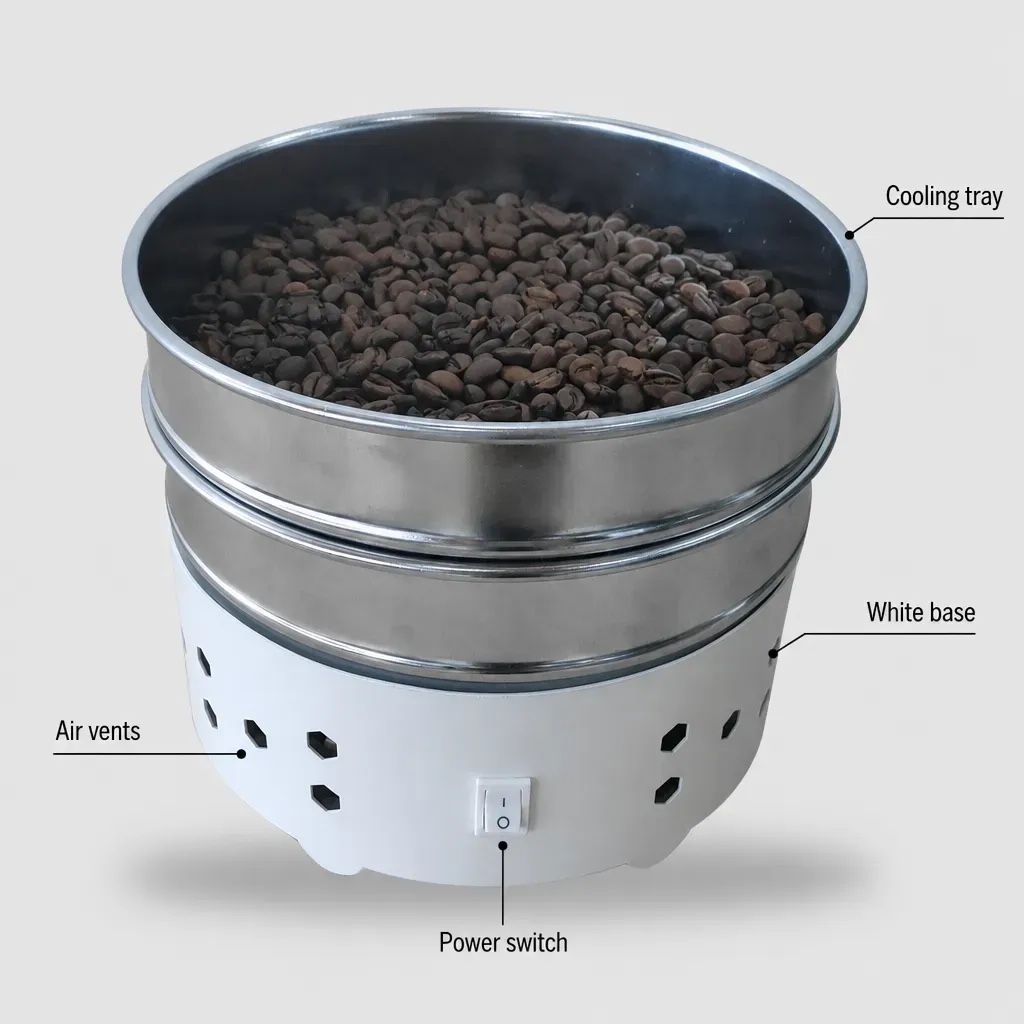
Short answer: Move the batch into a clean cooling tray promptly, spread it to a consistent depth and record elapsed time plus an end condition you can reproduce. Spread a 360 g dump on the 5-mesh sieve, switch on, and stir so the beans do not sit in a hot pile.
This 360 g ceramic-white cooler sits next to a home roaster. Tip hot beans onto the upper 5-mesh sieve. Start from the 360 g cooler product page. Switch on the rocker, stir, then empty the 60-mesh chaff tray.
The decision this page helps you make
Build a repeatable post-drop cooling record using time, bean depth and end temperature. That means defining a pass condition before buying, fitting or using anything. This ceramic-white version is the 360 g cooler. The tray is 17.5 cm across.
This cooler is: This ceramic-white version is the 360 g cooler. The tray is 17.5 cm across. The fan in the painted-metal base is 20 W at 3,300 rpm, on 220–240 V, 50 Hz. Tip hot beans onto the upper 5-mesh sieve, switch on the 20 W fan, and empty the 60-mesh chaff tray when you are done.
The non-negotiable boundary is equally important: Cooling performance changes with batch mass, bean depth, room temperature and airflow. Keep the dump in a thin layer, switch on the rocker, and stir so heat and chaff leave the beans.
A practical step-by-step workflow
- Step 1: Record roasted batch mass at drop.
- Step 2: Confirm the tray and screen are clean and dry.
- Step 3: Start airflow promptly and spread beans to an even depth.
- Step 4: Record room temperature and the time cooling begins.
- Step 5: Stir only in a repeatable way that does not contact the fan.
- Step 6: Measure or define the same end condition for each batch.
- Step 7: Log time, end temperature, chaff behaviour and any retained heat pockets.
Carry out the checks in order. For this specific decision, record the exact identity, the starting condition, the setting or method used and why the outcome was accepted or rejected. That turns a later change into something that can be diagnosed instead of an anecdote.
Evidence table
| Record | Why it matters | What it can reveal |
|---|---|---|
| Roasted mass | Defines real load | Whether nominal capacity is being exceeded |
| Bed depth | Changes resistance to airflow | Hot spots under deep piles |
| Room temperature | Changes available cooling gradient | Seasonal timing differences |
| Elapsed time | Shows workflow repeatability | Drift caused by fouling or overloading |
Use the table as a stop/go record. When the current manual or service information gives a specific limit, that exact source takes priority over this general guide.
How this 360 g cooler fits the job
The 360 g tray is 17.5 cm across. Tip hot beans onto the upper 5-mesh sieve, switch on, and stir.
Common failure modes
- Quoting a cooling time without batch mass.
- Piling beans deeply in one area.
- Treating fan RPM as an independent cooling result.
- Letting chaff block the airflow path.
- Judging only by the top layer.
- Changing stirring method between batches while comparing times.
A documented stop decision protects the item and the diagnostic trail. It also makes a supplier question or return easier because the mismatch was recorded before damage or modification.
Read next
Use the product page for cooler details. Continue to coffee bean cooler explained a uk buyers guide, home coffee roaster cooling tray explained a uk buyers guide, roasted bean cooling tray explained a uk buyers guide only when that adjacent question becomes relevant. Together these pages cover buying, setup, evidence, maintenance and safety without repeating one broad buyer’s guide under several titles.
Frequently asked questions
What is the first check for this task?
Record roasted batch mass at drop. This first check matters because the rest of the workflow assumes the correct item, information and starting condition.
What result should be written down?
Record the result of “Log time, end temperature, chaff behaviour and any retained heat pockets.” together with the exact item or batch, relevant settings and any photograph or measurement that another person would need to repeat the decision.
Which product claim still needs verification?
This ceramic-white version is the 360 g cooler. The tray is 17.5 cm across. The fan in the painted-metal base is 20 W at 3,300 rpm, on 220–240 V, 50 Hz. Tip in the hot beans, switch on the rocker, and stir.
What is an immediate stop signal?
Quoting a cooling time without batch mass. is one avoidable failure. Also stop whenever cooling performance changes with batch mass, bean depth, room temperature and airflow. Keep the dump in a thin layer, switch on the rocker, and stir so heat and chaff leave the beans.
Sources and scope
Cooler details on this site are on the product page. Unplug before you rinse the painted-metal base and the 304 sieves.
These sources define principles within their stated scope. Switch off, pour the beans, then empty the lower sieve of chaff.
Bottom line
Move the batch into a clean cooling tray promptly, spread it to a consistent depth and record elapsed time plus an end condition you can reproduce. Spread a 360 g dump on the 5-mesh sieve, switch on, and stir so the beans do not sit in a hot pile. Stir while it runs so heat and chaff leave the beans. Empty the 60-mesh tray when you are done.